


Redefining Paper’s Role in High-Performance Packaging
Brands are demanding lower plastic content. Regulators are tightening end-of-life standards. Converters are under pressure to deliver recyclable, food-safe packaging — without sacrificing shelf life or machine uptime.
The result is a new phase in the paperisation movement: one where fiber plays a more active role in performance.
A Functional Barrier Built into The Sheet

Instead of relying solely on surface coatings, our vapor modulation treatment is embedded directly into the paper matrix—transforming the substrate from a passive carrier into an active layer of defense. By controlling moisture transport from within the sheet itself, we reduce both short-term humidity spikes and long-term vapor flux. This eases the burden on surface barriers, improves performance stability, and expands the operating window for downstream converting and packaging applications.
Our technology has demonstrated up to a 55% reduction in MVTR—enabling better performance with less polymer.
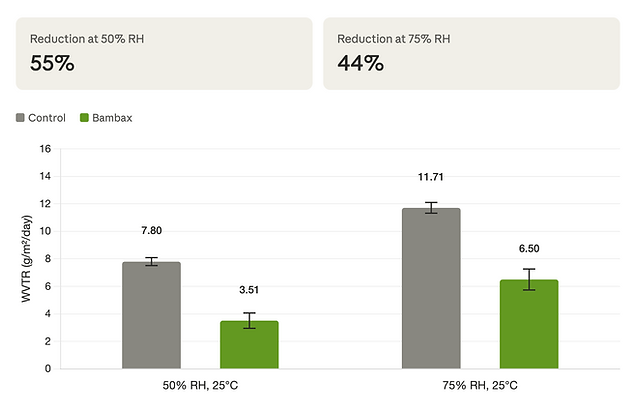
Unlike conventional barrier systems, the samples shown here contain no additional barrier coating. The performance improvement is generated by the Bambax treatment embedded within the paper substrate.
This is significant because it means the paper itself is contributing to moisture management. As a result, downstream barrier layers may be subject to less severe operating conditions, creating opportunities to improve overall system performance while reducing coating burden.
Rather than competing with conventional barrier technologies, Bambax is designed to complement them. By improving the contribution made by the paper substrate itself, existing polymer, mineral and bio-based barrier systems can operate more efficiently within the overall packaging structure.

Expand the Operating Window
Our technology enables converters to get more from existing barrier chemistries—improving performance without increasing polymer load. By moderating vapor transmission from within the fiber matrix, we ease the demands placed on surface coatings.
This expands the functional envelope for design and converting—making it easier to balance barrier performance, recyclability, cost per tonne, and product liability.
Minimal Adoption Friction
Our technology is designed to slot effortlessly into existing mill workflows and toll coating lines. No overhaul required—just a smarter chemistry step that works with your current fiber, drying, and barrier coating setup.
This means lower implementation risk, faster time-to-market, and the ability to scale without disrupting established production infrastructure.
Reduce Cost per Tonne Without Sacrificing Performance
Our approach enables mills and converters to achieve high barrier performance with less material. By optimizing how fiber and chemistry interact, we reduce the need for excessive coating—cutting material costs while maintaining functional integrity.
The result: lower cost per tonne, without compromising recyclability or shelf-life performance.